DONIBANE Scholar 2025

ACROSS FRONTIERS

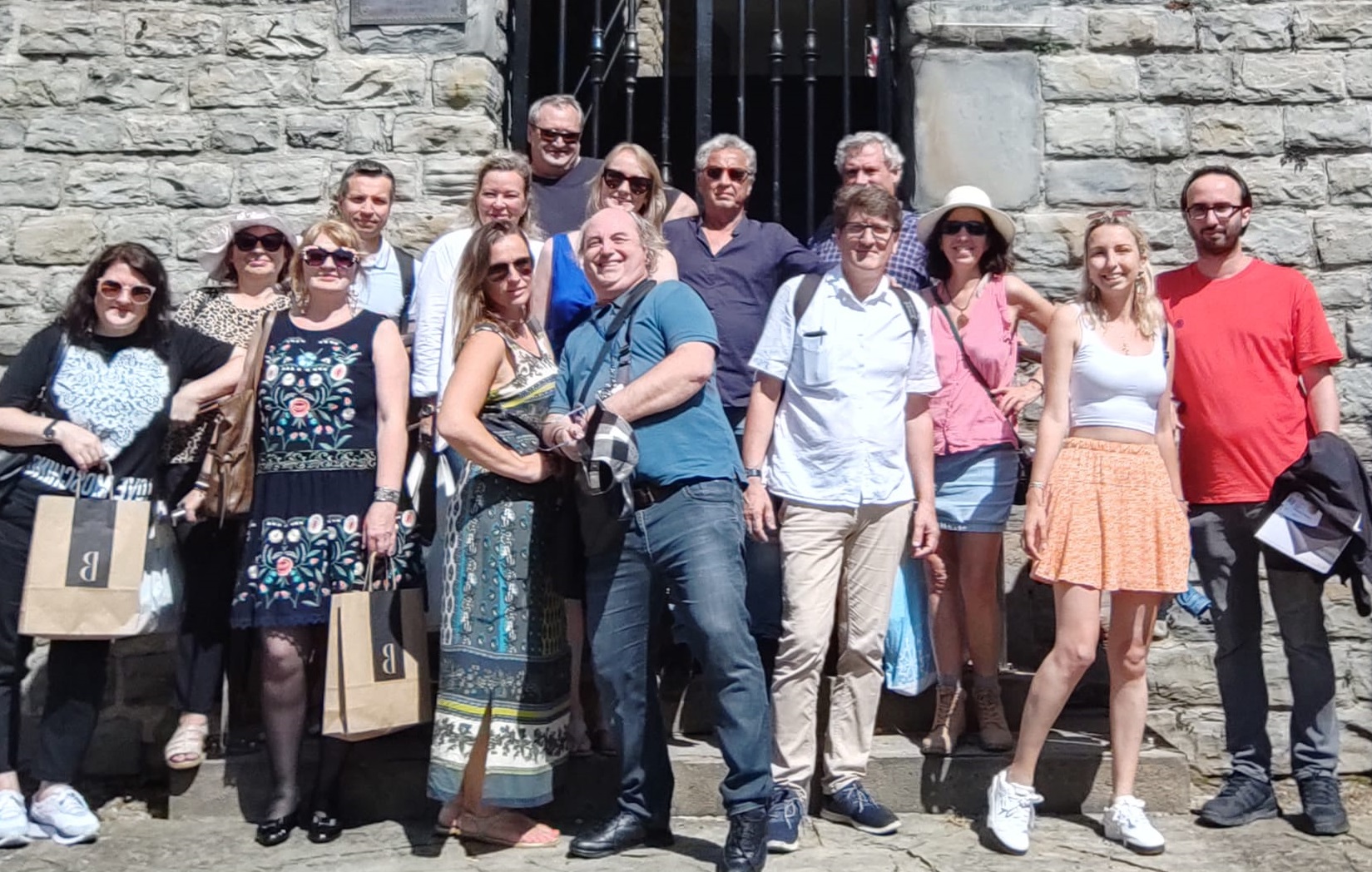
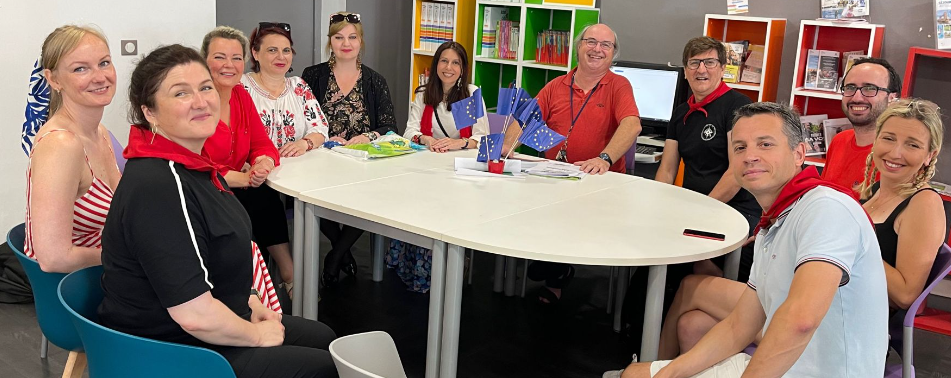
Réunion de travail au Lycée Ravel, entre midi et 14 h
en présence de responsables du dispositif pédagogique ACMÉ (Mme Sierra, coordinatrice au Lycée Ravel / Mme Aguinaga, coordinatrice à l'IES Plaza de la Cruz, Mme Bilbao, de l'IES "Uribarri BHI" à Basauri etc.) et des pilotes du projet (le Président de la Ligue et  le Trésorier, la chargée du suivi du dispositif ACMÉ RESISTANCE au sein de la Ligue).

sp3
>L'association Ligue ILARGIA
Elle a été créée en 2018 (par des professeurs de cinq pays européens différents, au départ réunis dans le partenariat innovant NUITS BLANCHES ERASMUS+). Ont rapidement adhéré à l'association - de Droit Français, mais dont le recrutement se veut continental - des professeurs Catalans (à l'initative d'un progesseur de Girona, membre, comme le Président fondateur de la Ligue de l'équipe portant un projet COMENIUS terminé en 1999).
On rappelle ses objectifs initiaux et ses intentions à court et moyen terme : le présent colloque DONIBANE Scholar 2025 vise en particulier à étendre le vivier des partenaires potentiels de la Ligue ILARGIA, pour lancer des candidatures parallèles au programme ERASMUS+ tout en créant un réseau informel d'écoles secondaires collaborant en distanciel avec la Ligue et le Lycée Ravel, éventuellement en dehors de subventions européennes spécifiques (à cet égard, le réseau eTwinning représente un outil pour valoriser de telles collaborations et permettre en quelque sorte leur validation a posteriori, toujours utile afin de soumettre une candidature à un partenariat relevant de la clé-2 et obtenir des fonds européens).
>Le projet ACMÉ, devenu ACMÉ RESISTANCE, et ses premiers résultats en 2025 (dans chacun des deux volets FIGHT FOR FREEDOM et RESILIENCE)
On procède à l'évocation rapide des perspectives concernant le développement du Twinspace de ce projet, et les tâches pouvant être conduites en commun,  à distance ou non – présentation des résultats publiés (sur ce site pour ce qui concerne FFF et sur le site Noah pour le projet RESILIENCE). L'on s'accorde pour aller au delà, en 2026, du simple échange de résultats, et pour chercher à implanter des ateliers communs (co-working) comme cela a pu être fait avec Pampelune, voire des échanges (par exemple, l'idée lancée entre Basauri et Saint-Jean-de-Luz d'un séjour croisé)
L'examen des projets de mobilités entre Pays Basque et Pologne - en particulier celles intéressant le Lycée Ravel et celui de Kwidzyn.
Une mobilité entrante (non subventionnée) est prévue en France pour l'équipe du Społeczne Liceum Ogólnokształcące im. Polskich Noblistów (sans doute en mai, réalisée sans aide européenne, avec un hébergement dans des familles de lycéens français de première – âgés de 16 ou 17 ans, par conséquent – lesquels prendraient part à un voyage en sens inverse en 2027).
Une mobilité sortante de lycéens français de Terminale (18 ans) est programmée vers Kwidzyn (Cracovie et Gdansk) probablement en avril, dans le cadre de mobilités accréditées (hébergement à l'hôtel).
Quelques écoles secondaires implantées dans les PECO et des lycées du Pays Basque sont censées constituer le coeur-de-cible d'ACMÉ. En plus du lycée de Kwidzyn, nous avons des relations suivies avec les écoles secondaires de Baldone (Lettonie) et Cluj-Napoca (Roumanie) et nous souhaitons approfondir les liens avec le Lycée Logisitique et Écologique de Gdynia.

sp2

>La démarche intersectorielle du lycée Ravel et la méthode NOAH
On souligne la similitude entre celle-ci et la démarche du "New Bauhaus", soulignée à l'occasion de la remise du prix EITA (du projet le plus innovant) donné au partenariat ERASMUS+ E+A (Noah) en 2022. Les partenariats que nous élaborons et coordonnons depuis le Lycée Ravel constituent à chaque fois un pont transdisciplinaire entre les connaissances, relevant de la Science, et les savoir-faire, notamment sur le plan Littéraire, pour aboutir à un projet culturel basé sur une ou des composantes artistiques et portent une double ambition conviviale et civique, soulignant notre responsabilité, à l'égard du Vivant, notamment.

On revient sur l'intérêt (et la difficulté) d'introduire dans les partenariats des entités non scolaires. Notre expérience d'une telle ouverture est fructueuse (avec la commune, son service Jeunesse, des associations telles que la CIMADE, des entreprises sociales comme la MAIF) mais la formalisation de tels liens est compliquée, leur valorisation dans le cadre de candidatures au programmes ERASMUS+ hypothétique. L'Agence Erasmus+ semble avoir des priorités nationales qui, dans les fait, conduisent à privilégier les acteurs traditionnels, en dépit du discours produit. De même, l'éclatement des projets en modules distincts a semblé gêner, parfois, notre démarche pédagogique, qui reste résolument transversale, et l'injonction reçue de ne pas réserver au budget des mobilités une portion autre que congrue a représenté une complication pour le suivi financier

>Le futur colloque international sur les frontières : MUGA Genius 2026 ("des murs et des ponts") ; point sur PARTENAIRES / PUBLIC / CALENDRIER
Son implantation en mai 2026 conduirait si la même semaine de ce mois était privilégiée à combiner les mobilités entrantes d'un partenariat innovant (Be.Bo.P) et les activités du réseau ACMÉ (voyage de Polonais en France, présence d'enseignants voire d'apprenants du Pays Basque).
La participation de parlementaires nationaux et d'élus régionaux, de délégations des deux eurorégions pyrénéennes voire de l'association catalane ACESC et d'universitaires Bayonnais sont envisagés.

sp1

Un consensus est constaté sur tous ces sujets entre les écoles représentées. A noter que le BHI Beasain a l'expérience de son propre réseau d'écoles européennes et a pratiqué toute la gamme de projets et partenariats ERASMUS+ quand d'autres partenaires sont débutants, certains restant non accrédités à ce jour : le dispositif ACMÉ est riche de ces différences. On prévoit de proposer à chacun des partenaires situés en Espagne de prendre part avec la Ligue et/ou le Lycée Ravel à une candidature ERASMUS+

ENGLISH TRANSLATION

>The Ligue ILARGIA Association>
It was created in 2018 (by professors from five different European countries, initially united in the innovative NUITS BLANCHES ERASMUS+ partnership). Catalan professors (members, like the founding president of the Ligue, of a COMENIUS project completed in 1999) quickly joined the French-law association, which aims to recruit from across the continent. We recall its initial objectives and its short and medium term intentions: the present DONIBANE Scholar 2025 conference aims in particular to expand the pool of potential partners of the ILARGIA League, to launch parallel applications to the ERASMUS+ program while creating an informal network of secondary schools collaborating remotely with the League and the Lycée Ravel, possibly outside of specific European subsidies (in this respect, the eTwinning network represents a tool to promote such collaborations and to allow their validation a posteriori, always useful in order to submit an application to a partnership under key-2 and obtain European funds)

>The ACMÉ project, wich is now called  ACMÉ RESISTANCE, and its initial results in 2025 (in each of the two components: FIGHT FOR FREEDOM and RESILIENCE)>
We briefly discuss the prospects for developing this project's Twinspace, and the tasks that could be carried out jointly, remotely or not. We present the published results (on this site for the FFF and on the Noah site for the RESILIENCE project). We agree to go beyond simply sharing results in 2026, to implementing joint workshops (co-working) and even exchanges (for example, the idea of ​​a joint stay between Basauri and Saint-Jean-de-Luz).
We examine mobility projects between the Basque Country and Poland, particularly those involving the Ravel and Kwidzyn high schools. An incoming (unsubsidized) mobility is planned in France for the Społeczne Liceum Ogólnokształcące im. Polskich Noblistów team (probably in May, carried out without European aid, with accommodation with families of French high school students in their first year of secondary school – aged 16 or 17, therefore – who would take part in a return trip in 2027).
An outgoing mobility of French high school students in their final year of secondary school (18 years old) is planned for Kwidzyn, probably in April, as part of accredited mobility (hotel accommodation).
A few secondary schools located in the Central and "Eastern" (former communist) European countries and high schools in the Basque Country are expected to constitute ACMÉ's core target. In addition to the Kwidzyn High School, we have ongoing relationships with the secondary schools of Baldone (Latvia) and Cluj-Napoca (Romania) and we would like to deepen the links with the Logistics and Ecological High School of Gdynia

>The Lycée Ravel's intersectoral approach and the NOAH method
We highlight the similarity between this approach and the New Bauhaus approach, highlighted during the EITA award ceremony for the most innovative project given to the ERASMUS+ A+A (NOAH) partnership in 2022. The partnerships we develop and coordinate from Lycée Ravel each time constitute a transdisciplinary bridge between knowledge, relevant to science, and know-how, particularly in literature, to result in a cultural project based on one or more artistic components with a dual ambition: convivial and civic, emphasizing our responsibility towards the living world.

We return to the interest (and difficulty) of introducing non-school entities into partnerships. Our experience of such openness is fruitful (with the municipality, its Youth Service, associations such as CIMADE, social enterprises such as MAIF) but the formalization of such links is complicated, their valorization in the context of applications to the ERASMUS+ programs hypothetical. The Erasmus+ Agency seems to have national priorities which, in fact, lead to favoring traditional actors, despite the discourse produced. Similarly, the splitting of projects into separate modules seemed to hinder, at times, our pedagogical approach, which remains transversal, and the injunction received not to reserve a portion of the mobility budget other than a small portion represented a complication for the financial monitoring..

>The future international conference on borders: MUGA Genius 2026 ("Walls and Bridges"); update on PARTNERS / PUBLIC / CALENDAR>
Its implementation in May 2026 would, if the same week of that month were chosen, lead to the combination of inbound mobility from an innovative partnership (Be.Bo.P) and the activities of the ACMÉ network (travel by Poles to France, presence of teachers and even learners from the Basque Country).
The participation of national parliamentarians and regional elected officials, delegations from the two Pyrenean Euroregions, the Catalan association ACESC, and academics from Bayonne are envisaged.

A consensus has been reached on all these topics among the schools represented. Please note that the BHI Beasain has experience with its own network of European schools and has practiced the full range of ERASMUS+ projects and partnerships while other partners are beginners, some of which remain unaccredited to date: the ACMÉ system is rich in these differences. We plan to offer each of the partners located in Spain the opportunity to take part with the League and/or the Lycée Ravel in an ERASMUS+ application.


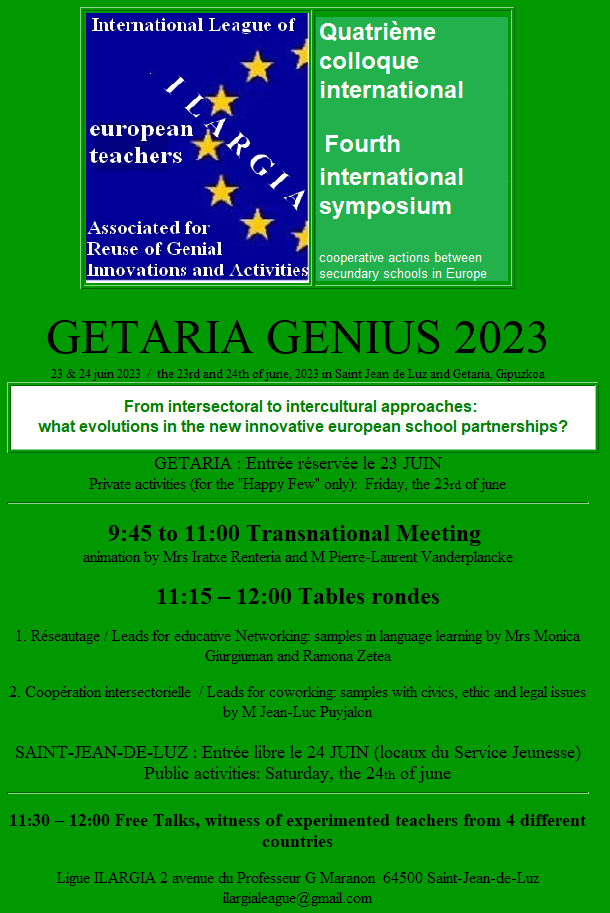
GETARIA GENIUS 2023

ABSTRACTS

Jean-Luc Puyjalon was the animator of WORKSHOP 2. He explained in two words what are exactly intersectoral activities..

 JLP


Intersectoral collaboration

It is an approach that comes from Canada and has been theorized particularly in the field of public health:

References:

  • Collaboration and Partnerships for Healthy Communities

(Ontario Healthy Communities Coalition)

  • Les collaborations intersectorielles et l’action en partenariat, comment ça marche ?

(Angèle Bilodeau André-Anne Parent Louise Potvin)

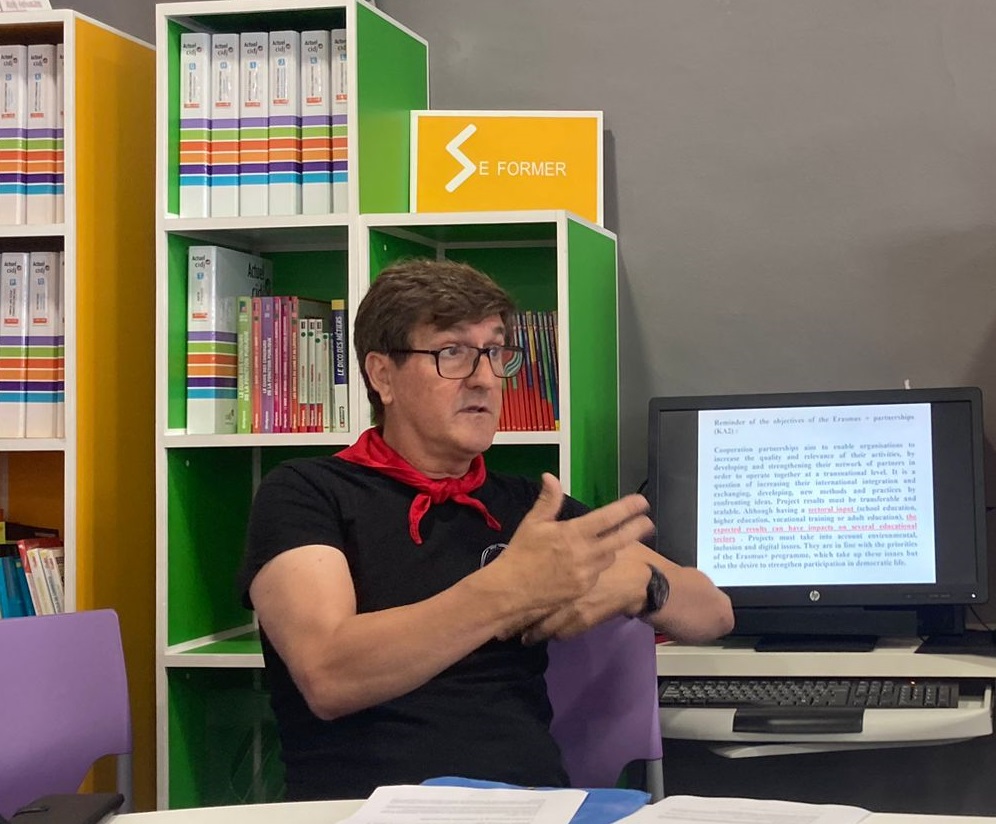
Reminder of the objectives of the Erasmus + partnerships (KA2)

Cooperation partnerships aim to enable organisations to increase the quality and relevance of their activities, by developing and strengthening their network of partners in order to operate together at a transnational level. It is a question of increasing their international integration and exchanging, developing, new methods and practices by confronting ideas. Project results must be transferable and scalable. Although having a sectoral input (school education, higher education, vocational training or adult education), the expected results can have impacts on several educational sectors . Projects must take into account environmental, inclusion and digital issues. They are in line with the priorities of the Erasmus+ programme, which take up these issues but also the desire to strengthen participation in democratic life.

I. General principles of intersectoral collaboration

a) What is it?

Intersectoral collaboration, intersectoral action and multisectoral partnerships are all terms that refer to an approach whereby a grouping of partners from different origins and sectors work together on an issue of common interest.

This approach is based on the premise that solutions go beyond the provision of knowledge transfer and are often found outside the education sector itself.

The benefits of intersectoral action are to foster new practices and innovation, reduce duplication of programmes, increase opportunities for action at different levels of determinants, and increase the potential for impact of interventions by pooling funding and resources.

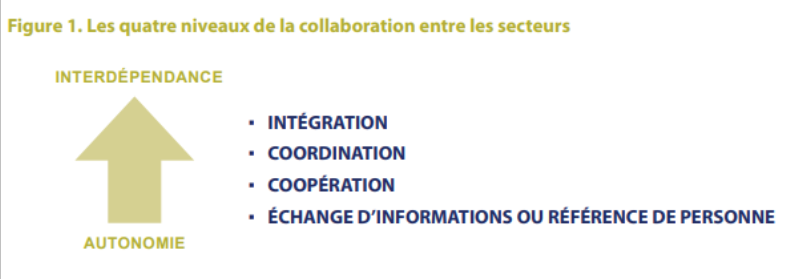
Four components of the intersectoral collaboration process

JL1

the end THEN THE SAME post in french/

b) What are the goals?

Cross-sectoral coordination involves working together between different sectors or entities to make mutual adjustments to interventions to make them more coherent and robust in order to achieve joint goals.

Its purpose is to develop answers to complex problems that organizations, alone, could not solve.

Partnership action involves the pooling of knowledge and resources.

JL2c) Are there any obstacles?

The challenge of intersectoral action lies in the fact that it must address a diversity of issues intertwined by the application of sectoral, disciplinary or professional knowledge and practices, and different perspectives on problems and solutions.

Warning: Greater interdependence in collective action is accompanied by a loss of autonomy for each actor.

II - Practicals applications (our examples)

The Beyond Boundaries People Project

- Schools (Lycée Maurice Ravel / Colegiul Economic Iulian Pop (Cluj-Napoca) / Rigas Raiņa vidusskola / Cesme / Rome)


The ACME project (ALL CITIZENS: MANKIND ERASMUS+)

- Etablissements scolaires (Lycée Maurice Ravel / Colegiul Economic Iulian Pop (Cluj-Napoca) / Ozel Cesme Bilgic Anadolu Lisesi / veterinary medicine 'Prof. d-r. Georgi Pavlov' Dobrich / Skola mezinarodnich averejnych vztahu Praha / Ogólnokształcące im. Polskich Noblistów

Let's take the example of the ACME project, an intersectoral collaboration between:

  1. Ilargia (cultural association)
  2. Project schools
  3. Iratxe Renteria (Berritz Egune, gouvernement basque)
  4. Academic Institution: School of Legal Training (Rectorate of Bordeaux)
  5. UPPA (European and International Studies)
  6. Sports associations (Aviron Bayonnais, Comité Départemental Aviron)


Responsibility and citizenship

CITIZENS' RIGHTS

LIMITATIONS OF CITIZENSHIP

DUTIES OF CITIZENS


III. The relevance of third places

Third Place is a term translated from the English The Third Place referring to the social environments that come after home and work. This is a thesis developed by Ray Oldenburg, professor of urban sociology at the University of Pensacola in Florida, in his book published in 1989: The Great Good Place.

A third place is a physical space designed to accommodate a community in order to allow it to freely share resources, skills and knowledge.

The advantage is supposedly that we find ourselves on neutral ground: the third place is a place that does not entail any obligation from each other (for example guest / host), facilitating reflection in a serene and friendly atmosphere.

french text

La collaboration intersectorielle 

C’est une démarche qui vient du Canada et qui a été théorisée notamment dans le domaine de la santé publique :

Références :

  • Collaboration and Partnerships for Healthy Communities

(Coalition des communautés en santé de l’Ontario)

  • Les collaborations intersectorielles et l’action en partenariat, comment ça marche ?

(Angèle Bilodeau ■ André-Anne Parent ■ Louise Potvin)

Rappel objectifs des partenariats Erasmus + (KA2)

Les partenariats de coopération visent à permettre aux organismes d’accroître la qualité et la pertinence de leurs activités, en développant et renforçant leur réseau de partenaires afin d’opérer ensemble à un niveau transnational. Il s’agit d’accroître leur insertion internationale et d’échanger, développer, de nouvelles méthodes et pratiques en confrontant les idées. Les résultats du projet doivent être transférables et évolutifs. Bien qu’ayant une entrée sectorielle (enseignement scolaire, enseignement supérieur, formation professionnelle ou éducation des adultes), les résultats attendus peuvent avoir des impacts sur plusieurs secteurs éducatifs. Les projets doivent prendre en compte les questions d’environnement, d’inclusion et de numérique. Ils s’inscrivent dans les priorités du programme Erasmus+ qui reprennent ces questions mais également la volonté de renforcer la participation à la vie démocratique.

I. Principes généraux de la collaboration intersectorielle

  1. a) De quoi s’agit-il ?

La collaboration intersectorielle, l’action intersectorielle et les partenariats multisectoriels sont tous des termes qui se rapportent à une démarche par laquelle un regroupement de partenaires d’origine et de secteur distincts travaille de manière concertée sur une question d’intérêt commun.

Une telle démarche part du principe que les solutions dépassent la simple prestation de transmission de connaissances et qu’elles se trouvent souvent ailleurs que dans le secteur de l’éducation proprement dit.

L’action intersectorielle a pour avantage de favoriser les nouvelles pratiques et l’innovation, de réduire la duplication de programmes, d’accroître les possibilités d’action à différents niveaux de déterminants et d’accroître le potentiel d’impact des interventions en mettant en commun les financements et les ressources.

Quatre composantes du processus de collaboration intersectorielle :

  1. b) Quels sont les buts ?

La coordination intersectorielle implique un travail conjoint entre des secteurs distincts ou des entités différentes pour apporter des ajustements mutuels aux interventions de sorte à les rendre plus cohérentes et plus solides afin d’atteindre des buts conjoints.

Son but est de développer des réponses à des problèmes complexes que les organisations, isolément, ne pourraient pas résoudre.

L’action en partenariat implique la mise en commun de savoirs et de ressources.

  1. c) Y a-t-il des obstacles ?

La difficulté de l’action intersectorielle réside dans le fait qu’elle doit faire face à une diversité d’enjeux entremêlés par la mise en de savoirs et de pratiques sectoriels, disciplinaires ou professionnels, et de perspectives différentes sur les problèmes et les solutions.

Attention : Une interdépendance plus grande dans l’action collective s’accompagne d’une perte d’autonomie de chaque acteur.

II - Applications concrètes (notre exemple)

Le projet Beyond Boundaries People

- Etablissements scolaires (Lycée Maurice Ravel / Colegiul Economic Iulian Pop (Cluj-Napoca) / Rigas Raiņa vidusskola / Cesme / Rome)

Le projet ACMÉ (ALL CITIZENS: MANKIND ERASMUS+)

- Etablissements scolaires (Lycée Maurice Ravel / Colegiul Economic Iulian Pop (Cluj-Napoca) / Ozel Cesme Bilgic Anadolu Lisesi / veterinarna medicina 'Prof. d-r. Georgi Pavlov' Dobrich / Skola mezinarodnich averejnych vztahu Praha / Ogólnokształcące im. Polskich Noblistów

Prenons l’exemple du projet ACMÉ, collaboration intersectorielle entre :

  • Ilargia (association culturelle)
  • Etablissements scolaires du projet
  • Iratxe Renteria (Berritz Egune, gouvernement basque)
  • Institution Académique : Ecole de formation juridique (rectorat de Bordeaux)
  • UPPA (Etudes Européennes et Internationales)
  • Associations sportives (Aviron Bayonnais, Comité Départemental Aviron)

Responsabilité et citoyenneté

DROITS DU CITOYEN

LIMITES DE LA CITOYENNETÉ

DEVOIRS DU CITOYEN

III - La pertinence des tiers-lieux

Tiers-lieu est un terme traduit de l'anglais The Third Place faisant référence aux environnements sociaux qui viennent après la maison et le travail. C'est une thèse développée par Ray Oldenburg, professeur de sociologie urbaine à l’université de Pensacola en Floride, dans son livre publié en 1989 : The Great Good Place.

Ub tiers lieu est un espace physique prévu pour accueillir une communauté afin de permettre à celle-ci de partager librement ressources, compétences et savoirs.

L’avantage est censément que l’on s’y retrouve en terrain neutre : le tiers-lieu est un endroit n’entraînant aucune obligation de l'un envers l'autre (par exemple invité/hôte), facilitant la réflexion dans une atmosphère sereine et conviviale.

DONIBANE Scholar 2025

ACROSS FRONTIERS

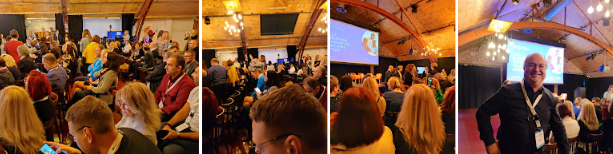
Le cinquième colloque international organisé par la Ligue s'est tenu le 18 juin 2025, avec pour principale ambition celle de définir l'avenir du projet ACMÉ RESISTANCE, grâce à la présence des acteurs locaux et régionaux (du Pays Basque de France et d'Espagne) impliqués dans ce dispositif. En même temps, une réflexion plus large était conduite sur les moyens de collaborer malgré les frontières... et de concevoir des projets adaptés aux attentes des institutions (notamment celles de la commission et des agences ERASMUS+).

En marge de cet évènement, la Ligue a aussi pris sa part des commémorations organisées par la Ville. Il s'agissait d'honorer la mémoire des Résistants mais aussi l'amitié franco-polonaise et le souvenir d el'opération ARIEL. A cet égard, la présence de Mme Baas, enseignante au lycée de Kwidzyn (partenaire historique du Lycée Ravel dans le cadre du programme ERASMUS+) et membre active de notre association, était symbolique à plus d'un titre. Son établissement fait en effet partie du réseau ACMÉ - et des échanges d'élèves sont prévus, pour cette raison, entre Saint-Jean-de-Luz et la Poméranie, en 2026 et 2027. Par ailleurs, le lycée polonais et le lycée françsis ont déposé ensemble une candidature à un futur PPS (projet de partenariat simplifié innovant, dans le cadre de l'action clé-2). Enfin, Mme Baas a pu rencontrer certaines forces vives du territoire avec lesquelles la Ligue et le Lycée tentent de coopérer dans une démarche intersectorielle.

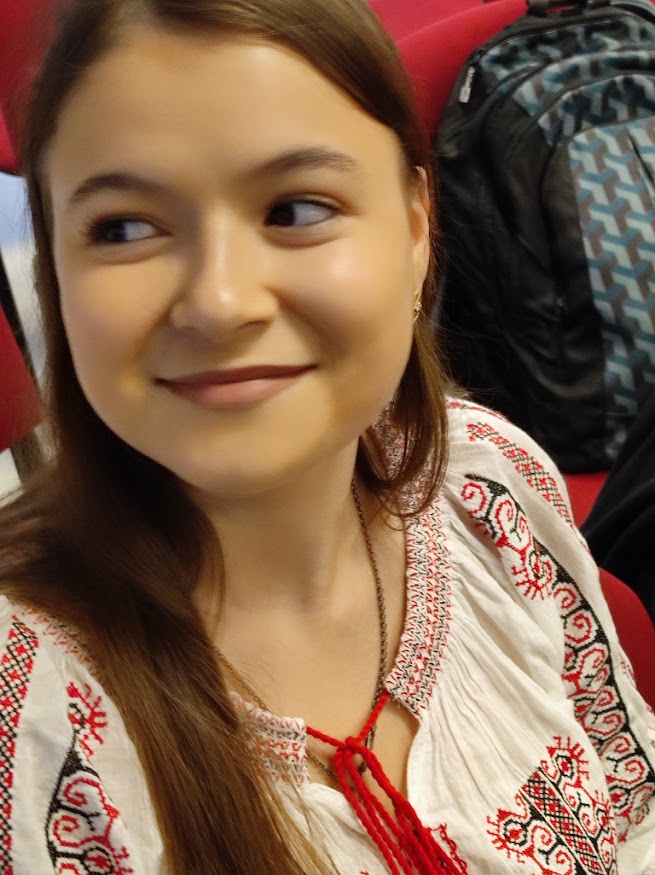
Son expérience lors des quelques jours passés en France grâce à l'invitaion lancée par la Ligue a fait l'objet d'une médiatisation par son école secondaire.


POL


The fifth international conference organized by the League was held on June 18, 2025, with the main ambition of defining the future of the ACMÉ RESISTANCE project, thanks to the presence of local and regional actors (from the Basque Country of France and Spain) involved in this initiative. At the same time, a broader reflection was conducted on the means of collaborating across borders... and of designing projects adapted to the expectations of the institutions (in particular those of the ERASMUS+ commission and agencies). On the sidelines of this event, the League also took part in the commemorations organized by the City. The aim was to honor the memory of the Resistance fighters, but also Franco-Polish friendship and the memory of Operation ARIEL. In this regard, the presence of Ms. Baas, a teacher at the Kwidzyn high school (a long-standing partner of the Ravel high school in the ERASMUS+ program) and an active member of our association, was symbolic in more ways than one. Her school is part of the ACMÉ network - and student exchanges are planned, for this reason, between Saint-Jean-de-Luz and Pomerania in 2026 and 2027. Furthermore, the Polish high school and the French high school jointly submitted an application for a future PPS (innovative simplified partnership project, as part of Key Action 2). Finally, Ms. Baas was able to meet some of the local forces with whom the League and the High School are trying to cooperate in an intersectoral approach.

Zoom out to 50% and turn the phone to landscape mode to visit the site / open QUINTESSENCE in an external browser please

CLUJ-NAPOCA Genius 2022

ENTITLED: What is a good european project between secondary schools?

symp1

SEE ALSO A SHORT REPORT IN THE ILARGIA BLOGSPOT


LAST GA (the fifth one): was implemented in Cluj-Napoca the 10th of November, 2022!

AT 7: 00 PM (ROMANIAN HOUR) OR 6 : 00 PM (Heure Française)

CLICK  BELOW  TO ACESS TO THE ILARGIA LEAGUE BLOGSPOT (GA reports):
bxm


THIRD ILARGIA LEAGUE SYMPOSIUM

implemented ONLINE and/or at the Inspectorate in Cluj-Napoca, Romania - collloque suivi en ligne ou en présentiel, organisé dans les locaux de l'Inspectorat de Cluj-Napoca (Roumanie)

TROISIÈME COLLOQUE INTERNATIONAL LES 10 ET 11 NOVEMBRE 2022 
 Il s'est agi de partager notre expertise (présumée ?)  après plusieurs années de coopération transnationale couronnée par des labels de qualité et la remise du prix EITA 2022 au partenariat ERASMUSPLUSANIMALS E+A (Noah) coordonné par le Lycée Ravel de Saint-Jean-de-Luz. L'événement était co-organisé par la Ligue ILARGIA et le colegiul  economic "Iulian Pop".
 
CEIP
 
CLUJ-NAPOCA Genius 2022
 
PUBLIC SYMPOSIUM
PARTIE PUBLIQUE DU COLLOQUE
the 10th and 11th of november
THE AGENDA: schedule done before the multiplier event 
I - Symbolic ceremony to showcase the EITA award 2022 at 4.30 PM (local hour)
Remise d'un certificat à notre partenaire roumain, le colegiul Economic "Iulian Pop" représenté par le chef d'établissement, Mme Stanca Vescan, Directrice : à 17 h 30 (heure française)
II - LECTURES:
 
WHAT IS A GOOD EUROPEAN PROJECT ? (English) / Conférences sur le thème : Qu'est-ce qu'un bon projet européen ? 
then by some students, especially Mrs Maria Maier 
Presentation by Mr Pierre-Laurent Vanderplancke Sept ans de coopération et quatre projets communs
END at 6:30 PM (local hour) then certificates of attendance given by the local parner to Romanian participants

PUBLIC SYMPOSIUM ; REMOTE WORKSHOP -  ATELIER EN DISTANCIEL the 11th of november

concrete questions to project holders - Pierre-Laurent Vanderplancke et Jean-Luc Puyjalon en visioconférence

LIVE DISSEMINATION from 4.30 to 6.00 (local hours) the 10th and from 9:00 to 9:45 the 11th
diffusion de 4 h 30 à 6 h (ou de 17 h 30 à 19 h à Paris, Londres ou Saint-Jean-de-Luz)
europe


prix


LIVE DISSEMINATION OF THE GA: from 7 PM to the end (local hours)

IL3


Page 1 sur 2

partenariat ERASMUS+ NUITS BLANCHES NBE+ 2015-2018 et eTwinning ILARGIA / coordination internationale Vanderplancke P-L / EUROPEAN LEAGUE OF TEACHERS SINCE 2018